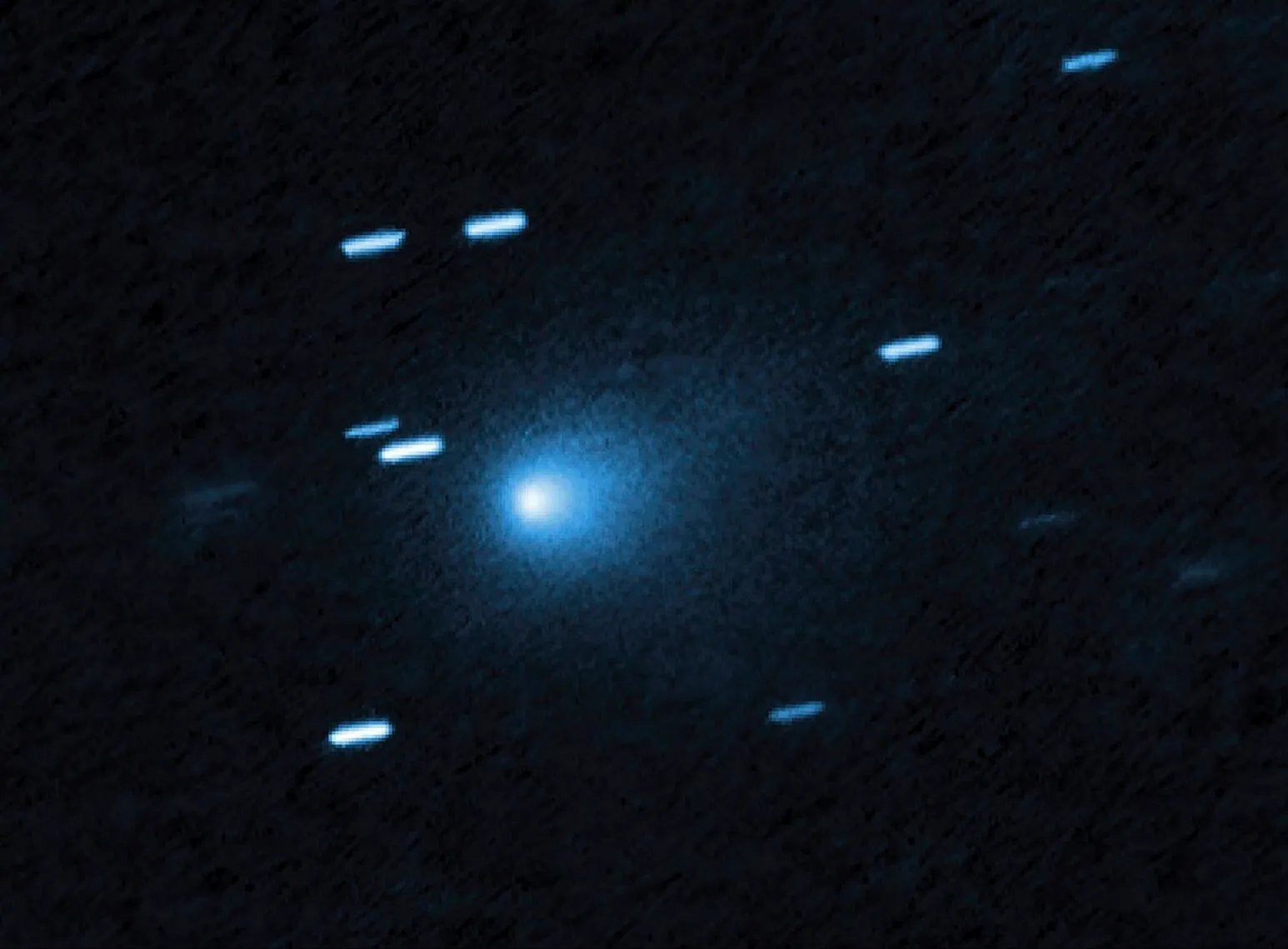
An Unusual Visitor Raises New Scientific Questions
A recent article by Harvard astrophysicist Avi Loeb has reignited scientific curiosity around the mysterious interstellar comet 3I/ATLAS, an object currently being studied by NASA and global observatories. According to Loeb, new data suggest “remarkable anomalies” in the comet’s behavior, fueling debate over whether it could be a natural object—or something far more extraordinary.
Designated 3I/ATLAS, this is only the third confirmed interstellar object to pass through our solar system, following ‘Oumuamua (1I) in 2017 and Borisov (2I) in 2019. But what sets 3I/ATLAS apart is its unexpected acceleration and chemical composition, which deviate from predictions based on standard cometary physics.
The 3I/ATLAS Mystery Deepens
NASA’s initial observations suggested that 3I/ATLAS was a hyperbolic comet, meaning it originated beyond our solar system and is merely passing through. However, data collected by multiple telescopes—including the Hubble Space Telescope and Pan-STARRS—indicate a non-gravitational acceleration that cannot be easily explained by sublimation (the vaporization of ice that typically drives comet movement).
Loeb’s analysis raises a provocative hypothesis: What if 3I/ATLAS is not entirely natural? Drawing parallels with ‘Oumuamua, which displayed similar unexplained propulsion, Loeb suggests that the object’s shape, speed, and trajectory could point to artificial origins—perhaps even a mothership-like probe designed to explore or “seed” planetary systems.
A Hypothetical Connection to Jupiter
One of the most intriguing points in Loeb’s discussion involves the comet’s orbital alignment with Jupiter. According to his calculations, 3I/ATLAS’s path could allow it to deposit material or technology near the gas giant, intentionally or otherwise.
While this idea remains speculative, Loeb emphasizes that such a possibility should not be dismissed outright. “The scientific method requires us to follow evidence, not prejudice,” he wrote. “If the data reveal something inconsistent with our expectations, we must broaden our perspective.”
NASA scientists have taken a more cautious stance, focusing instead on collecting high-resolution spectroscopic data to analyze the comet’s composition and reflectivity, which may explain the acceleration without invoking artificial causes.
Scientific Debate Intensifies
The interstellar comet 3I/ATLAS continues to divide the scientific community. Traditional astrophysicists argue that dust jets or rotational torques may account for its movement. Others, inspired by Loeb’s open-minded approach, see it as an opportunity to explore non-traditional explanations, including interstellar technology.
Regardless of the outcome, 3I/ATLAS represents a rare opportunity for scientists to study a visitor from another star system—an object carrying material untouched by our Sun’s formation. If confirmed as natural, it could offer invaluable clues about planetary formation and interstellar chemistry.
A New Era of Cosmic Exploration
As NASA prepares for follow-up observations using the James Webb Space Telescope and ground-based arrays, 3I/ATLAS is fast becoming a symbol of scientific curiosity and debate. Whether it’s a cosmic rock or a relic of interstellar engineering, the object challenges humanity to question the limits of what we consider possible.
As Avi Loeb concludes in his essay, “If we discover that 3I/ATLAS carries signs of technological origin, it will not diminish our place in the cosmos—it will expand it.”For more on emerging discoveries in astronomy, space science, and innovation, visit StartupNews.fyi.


