

eCommerce
Karnataka Gig Workers Welfare Board: Platforms to Pay Social Security Fee
Karnataka has formally operationalised a statutory welfare board under the Karnataka Platform-Based Gig Workers (Social Security & Welfare) Act, 2025, requiring digital platform aggregators to contribute a capped fee to finance social security benefits for gig economy participants. This marks one of the first state-level efforts in India to translate legislative intent into implementation mechanisms […]

Karnataka has formally operationalised a statutory welfare board under the Karnataka Platform-Based Gig Workers (Social Security & Welfare) Act, 2025, requiring digital platform aggregators to contribute a capped fee to finance social security benefits for gig economy participants. This marks one of the first state-level efforts in India to translate legislative intent into implementation mechanisms for a sector long characterised by informal work and limited benefits.
The move is set against broader national reforms under the Code on Social Security, 2020, which brought gig and platform workers under the ambit of social security schemes. Karnataka’s framework now provides a concrete institutional and funding structure to deliver those protections in practice.
A Board With Tripartite Representation
The Karnataka Platform-Based Gig Workers Welfare Development Board has been constitutionally notified, creating a statutory authority to oversee registration, welfare fund management, social security schemes, and compliance monitoring for aggregators and gig workers across the state.
Key structural elements of the board include:
- Chairmanship by the State Labour Minister, with senior government officials as ex-officio members.
- Four representatives nominated from gig worker unions and four from aggregator platforms.
- Inclusion of members with expertise in labour policy, technology systems, and data governance.
This tripartite representation is meant to balance the interests of workers, platforms, and the state in managing welfare initiatives.
Mandatory Registration and Welfare Fund Framework
With the board in place, registration requirements take effect:
- Aggregator platforms must register with the board and submit details of all engaged gig workers within 45 days.
- Each registered gig worker receives a unique identification number to access welfare benefits.
- A Gig Workers Welfare Fund will be financed through a combination of aggregator fees, potential worker contributions, and state and central government grants.
The identification and registration infrastructure aims to create a more formalised worker base, facilitating benefit delivery and tracking.
Fee Structure: Platforms to Pay 1–1.5% With Caps
One of the most consequential aspects of Karnataka’s policy is the welfare fee imposed on platform aggregators.
- Platforms are required to contribute 1% to 1.5% of their commission earnings to the welfare fund.
- To mitigate impact, the state has imposed per-transaction caps — 50 paise, 75 paise, or Re 1 — varying by business model.
- Fee revenues are estimated to generate ₹250–300 crore annually, financing benefits across sectors.
Government officials have indicated that the levy could be revised upward — up to 5% if required to sustain comprehensive coverage.
What This Means for Platforms and Worker
For Aggregators
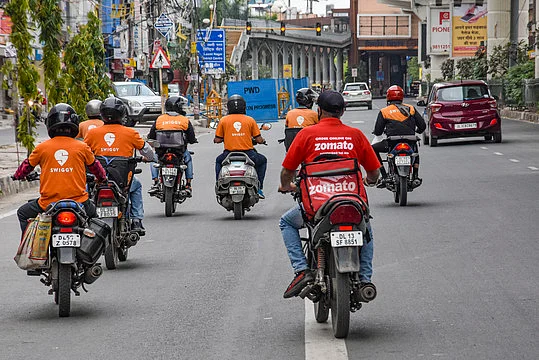
Mandating a fee on commissions introduces a new compliance and cost line item for app-based businesses in Karnataka. Major players in food delivery, ride-hailing, logistics, and quick commerce — such as Swiggy, Zomato, Blinkit, Uber, and Amazon’s delivery partners — fall under the framework.
Unlike employee wage costs, the welfare fee is not to be deducted from worker earnings, underscoring the state’s intent to ensure it is a platform liability. For smaller and niche platforms, the capped levy structure is designed to ease transition and operational compliance.
For Gig Workers
The framework gives gig workers formal recognition, a unique ID, and eligibility for state-mediated welfare benefits. While specific schemes are yet to be published by the labour department, social security measures could include insurance, health support, and other welfare provisions formerly absent in many gig arrangements.
This formalisation contrasts with the ad hoc nature of past protections and gives workers a clear institutional pathway to access support.
Broader Context: India’s Gig Economy Policy Landscape
Karnataka’s implementation follows earlier legislative moves, including the August 2025 passage of the state’s gig workers bill and draft rules on registration and governance.
Nationally, The Code on Social Security, 2020 extended social security definitions to include gig workers, though central rollout of detailed benefits has been gradual. Karnataka’s board operationalises the state adaptation of these national provisions.
Other states, like Telangana, have proposed welfare boards and broader gig worker bills emphasizing transparency, worker registration, and digital welfare fund mechanisms — indicating a wider policy trend.
What Happens Next
With the board constituted and levy notified, the Karnataka labour department is expected to issue detailed rules on registration processes, benefit design, grievance redressal, and fund utilisation. The first board meetings and digital infrastructure deployment for fee tracking are likely in the next few months.
For startups and aggregators, compliance systems — including worker data integration and weekly remittances — will need to be prioritised. Gig worker organisations and unions will be watching closely how funds translate into tangible coverage and protections on the ground.